

Last Updated: October 25, 2026
Quick Summary
To maintain show animal frame, provide a balanced ration with quality forage, appropriate grain and protein, matched supplements for each growth stage, and consistent daily exercise on varied terrain. Frame is genetic and sets the ceiling for development, while body condition is built through feeding, exercise, and management to reach the ideal range of 6 to 7.5 on a 1-to-9 scale.
- Body condition should be scored weekly on the same day in the same location, tracking ribs, loin, hip bones, and tail head to catch gradual changes early.
- A typical growing beef ration includes 60-70% forage, 20-30% grain, and 5-10% protein supplement with mineral and vitamin premix.
- Exercise 30 minutes daily on varied terrain; frequent moderate movement builds better muscle tone than sporadic intense work.
- Supplements should match growth stage: early grower needs calcium and phosphorus, mid-grower needs amino acids and B-vitamins, finishing phase needs joint support.
- Start conditioning 12-16 weeks before your target show, establishing baseline scores and photographs, then gradually increasing nutrition and exercise intensity.
Table of Contents
- Understanding Frame Condition in Show Animals
- Assessing Livestock Body Condition Scoring
- Developing a Show Animal Feed Ration
- Using Show Cattle Supplements for Frame Support
- Implementing a Show Animal Exercise Routine
- Daily Inspection and Maintenance Practices
- Building Your Show Season Frame Conditioning Plan
- Frequently Asked Questions
Understanding Frame Condition in Show Animals
Frame condition refers to the skeletal structure and overall size of a show animal at a given age, the genetic potential that determines capacity to develop muscle, bone density, and body composition.
A properly developed frame supports muscle deposition, connective tissue strength, and the polished finish judges reward. Without that foundation, even excellent nutrition and supplementation won't deliver results in the show ring.
Frame is genetic; body condition is what you build through feeding, exercise, and management. Both matter, but frame sets the ceiling.
Assessing Livestock Body Condition Scoring
Body condition scoring measures muscle and fat cover on an animal's frame at a given moment, letting you track progress weekly and adjust feeding (Body condition scoring: Monitoring beef cow energy reserves).
To assess body condition, you'll evaluate specific areas:
- Ribs: You should feel ribs easily but not see them prominently. They shouldn't be sharp or protruding.
- Loin and back: These areas should show fullness without excessive fat cover.
- Hip and pin bones: Feel these landmarks directly. They should be smooth and slightly rounded, not sharp or deeply buried.
Score animals on the same day each week, in the same location, under similar conditions.
Keep written records: date, animal ID, score, and notes on feed or exercise changes.
Developing a Show Animal Feed Ration
A balanced ration is the foundation of frame development, providing energy, protein, vitamins, and minerals in the right proportions for your animal's age, weight, and growth stage.
A typical growing beef animal ration might look like this:
- 60-70% forage (hay or pasture)
- 20-30% grain (corn, oats, or barley)
- 5-10% protein supplement
Forage quality matters: high-quality hay with good color, fine stems, and abundant leaves delivers more nutrients than stemmy, bleached hay.
Grain provides energy for growth.
Protein supplements, soybean meal, cottonseed meal, or commercial mixes, fill the gap between what forage and grain provide and what your animal needs.
You can build a solid foundation ration with basic ingredients. However, many exhibitors find that adding a comprehensive vitamin and mineral premix like NUTRIMIX ensures they're not missing critical micronutrients that support frame development and overall health.

Using Show Cattle Supplements for Frame Support
Supplements are the most overbought and under-measured part of most show programs. Before you add a single product, separate what supplements can actually do from what only genetics, age, and a balanced ration can do.
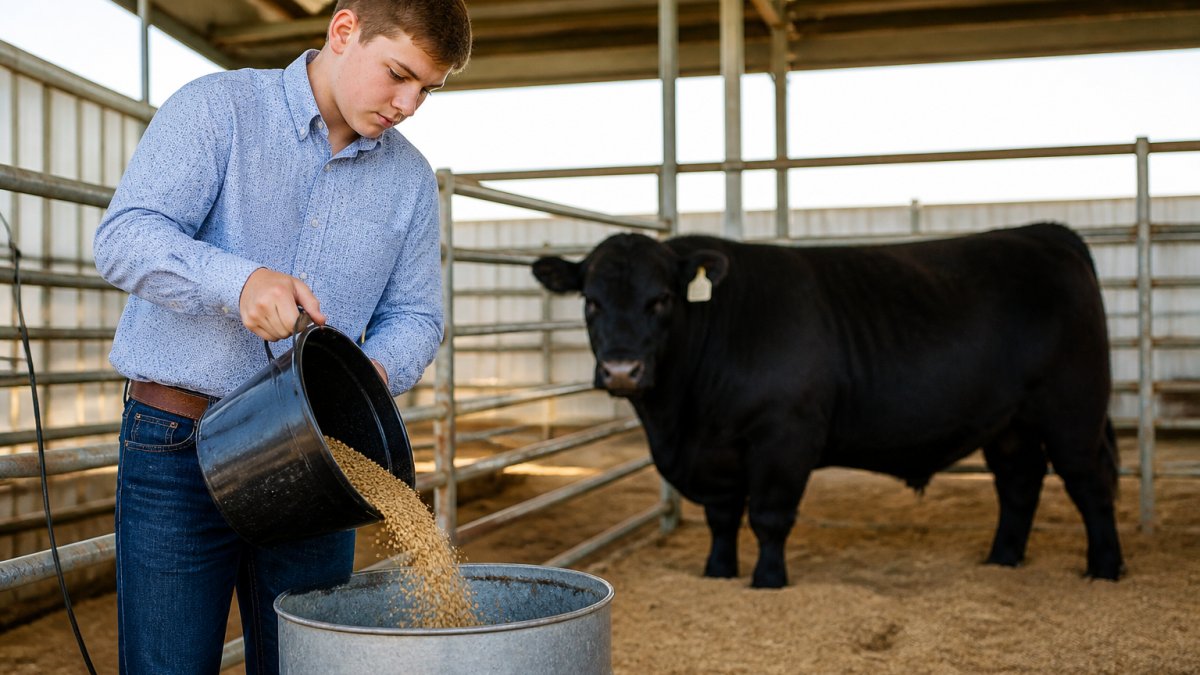
Match the supplement to the growth stage
Frame development is not linear, and the supplement program should not be either.
- Nursery and early grower (roughly the first third of the feeding period): prioritize highly available calcium and phosphorus, chelated zinc, copper, and manganese, and a quality vitamin A/D/E source. Bone deposition is most responsive early, and trace-mineral deficits in this window are difficult to correct later.
- Mid-grower: shift emphasis toward amino acid balance and B-vitamin support for muscle and appetite. Overfeeding calcium relative to phosphorus, or the reverse, is a common self-inflicted problem when exhibitors stack multiple mineral products.
- Finishing and fitting: joint and connective-tissue support (glucosamine, chondroitin, hyaluronic acid, MSM) and vitamin E become more relevant as body weight and exercise load rise. This is also when hair-coat supplements earn their cost.
Read the label like a nutritionist
- Check the calcium-to-phosphorus ratio on every mineral product you feed. Stacking a high-calcium frame product on top of an already balanced mineral premix is one of the most common causes of urinary calculi in male ruminants and of poor mineral absorption overall.
- Prefer chelated (organic) trace minerals when the budget allows; absorption is generally more consistent, especially when forage quality varies.
- Watch for duplicate ingredients. Two products with overlapping vitamin E, selenium, or copper can push intake past safe upper limits. Selenium in particular has a narrow margin between requirement and toxicity.
Dosing and timing that actually work
Follow the manufacturer's label for inclusion rate, then verify intake rather than assuming it. A common pattern is to top-dress the supplement on a small amount of feed so each animal gets its share, rather than mixing it into a group feeder where dominant animals overconsume.
FRAMEWORX is formulated around highly available calcium and phosphorus with chelated trace minerals for bone deposition, and MIGHTY VITE combines high-biological-value protein, amino acids, and a vitamin premix for muscle and overall conditioning.


Supplement priorities shift as animals progress through their growth stages.
| Growth Stage | Primary Focus | Key Nutrients |
|---|---|---|
| Nursery and early grower | Bone deposition | Calcium, phosphorus, chelated trace minerals, vitamin A/D/E |
| Mid-grower | Muscle and appetite | Amino acid balance, B-vitamin support |
| Finishing and fitting | Joint and connective tissue | Glucosamine, chondroitin, hyaluronic acid, MSM, vitamin E |
Implementing a Show Animal Exercise Routine
Exercise drives muscle development and cardiovascular fitness; without adequate movement, even perfectly fed animals won't develop the shape and definition judges reward.
Exercise type and intensity depend on age and training phase: young animals need frequent, moderate work, while mature animals in final fitting can handle more intensity.
Common exercise methods include:
- Walking: The foundation of any program. Walk your animals 30 minutes daily on varied terrain. Pasture walking is ideal because animals move naturally and encounter different surfaces.
- Driving: Use a show stick to move animals at a walk or trot. This teaches them to move correctly and builds muscle engagement.
- Treadmill work: Controlled exercise that builds consistent muscle development. Start at slow speeds and increase gradually.
Frequency matters more than intensity: brief daily movement outperforms sporadic hard work and builds better muscle tone and joint soundness.
Track exercise like feed and body condition, type, duration, intensity.
Daily Inspection and Maintenance Practices
Daily inspection is where your efforts to maintain show animal frame are either protected or quietly lost. The goal is to catch the small changes that precede lameness, digestive upset, and stalled growth, and tie what you see back to frame and condition targets for that animal's species, age, and show class.
A ten-minute frame-focused walkthrough
Work through the same sequence every day so nothing gets skipped:
- Gait and stance first. Watch the animal walk away from you and toward you on a hard, level surface. Short strides, a dropped hip, or a head-bob indicate joint or foot pain. Lameness during a growth phase is one of the fastest ways to lose frame development, because the animal stops moving and stops eating well.
- Joint and hoof heat. Run a hand down each leg and feel the joints and hoof wall for heat, swelling, or asymmetry. Compare left to right; subtle differences matter more than dramatic ones.
- Ribs, loin, and tail head. This is your daily body-condition check, not just a weekly one. You are feeling for change in cover, not re-scoring. Note whether ribs are becoming sharper or softening, and whether the tail head is filling in or hollowing out.
Species and age change what "normal" looks like
Frame and condition expectations are not interchangeable across species or growth stages, and judges evaluate them differently.
- Cattle: frame score is typically assessed on a 1-to-9 scale tied to hip height at a standard age, and body condition is scored separately. A young calf with a large frame and a condition score of 5 is not in the same place as a finished steer at 6.5 to 7.5.
- Sheep and goats: frame and condition are judged more on balance, width, and finish relative to breed and class. Condition scoring uses loin and spine palpation, and the acceptable range is narrower than in cattle.
- Swine: frame and condition are read through width, depth, and muscle shape; over-conditioning is a more common fault than under-conditioning in many show classes.
Records that make inspection useful
Keep a simple daily log with date, animal ID, gait notes, joint or hoof findings, appetite and water intake, and any feed or exercise change. Photograph each animal from the side, rear, and front on the same day each week under the same lighting. Weekly photos plus daily notes reveal trends that a single look cannot, and they give a veterinarian or nutrition professional something concrete to work from.
Maintenance tasks that protect frame condition
- Hoof care: check weekly and trim on a schedule appropriate to the species and growth rate. Overgrown or cracked hooves limit exercise and cause lameness that stalls frame development.
- Housing and bedding: clean daily. Dirty pens raise stress and disease risk, and stressed animals eat less.
- Water: fresh, clean water at all times. Animals under training or travel stress drink more, and reduced intake slows growth quickly.
Building Your Show Season Frame Conditioning Plan
A structured conditioning plan coordinates feeding, supplementation, exercise, and assessment into a timeline.
Week 1-4: Establish baseline. Score body condition, measure frame dimensions if possible, and photograph animals from multiple angles.
Week 5-8: Increase intensity gradually.
Week 9-12: Fine-tune and assess. Animals should be gaining steadily with improved muscle definition.
Week 13-16: Final polish. Reduce exercise intensity slightly to allow recovery and final conditioning. Maintain feeding levels.
Prioritize consistency over perfection.
Frequently Asked Questions
What does frame condition mean in a show animal?
Frame condition refers to the skeletal structure, bone density, and overall structural soundness of a show animal. A strong frame supports muscle development, joint health, and the animal's ability to carry weight and perform in the show ring. Frame is built through proper nutrition, mineral balance, and consistent management from a young age. Animals with well-developed frames display better posture, movement, and physical presence during judging.
How do livestock body condition scoring systems help maintain show animal frame?
Livestock body condition scoring uses a standardized scale (typically 1-9) to evaluate muscle and fat cover. Regular scoring helps you track whether your animal is gaining condition too quickly, too slowly, or at the right pace for your show date. By monitoring condition scores every 2-4 weeks, you can adjust feed rations and supplement use before problems develop. This prevents overfeeding, which can create excess fat that masks frame definition, or underfeeding, which compromises bone and muscle development.
Can supplements like HyFlex really improve joint soundness during show season?
Yes. Supplements formulated with hyaluronic acid, glucosamine, MSM, and natural Vitamin E support connective tissue strength and joint flexibility. During high-stress competition seasons, show animals experience increased wear on joints from transport, standing, and handling. Products like HyFlex ($148) are designed specifically for joint preventive maintenance and recovery, helping animals maintain soundness and mobility throughout the season. Proteinated trace minerals in supplements like Nutrimix ($225) also enhance nutrient absorption, supporting the bone and connective tissue development that underpins a strong frame.
How often should I adjust my show animal's feed ration during conditioning?
Evaluate your show animal's feed ration every 2-4 weeks based on body condition scoring and progress toward your target weight and finish. Early in the conditioning season, focus on balanced growth with adequate forage, protein, and minerals to build frame. As you approach show dates, adjust energy levels and supplement timing to polish finish without adding excess fat. Work with a livestock nutritionist if managing multiple animals in different weight classes, as each may need a customized ration to reach optimal condition safely.
Frame conditioning is a long-term investment in your show animals' potential. It requires attention to nutrition, supplementation, exercise, and daily management. Royal Grand supplements are formulated to support each phase of this process, providing the minerals, vitamins, and compounds your animals need to reach their full frame potential and deliver the polished finish that wins in the show ring.
