

Table of Contents
- What Joint Stiffness Looks Like in Show Goats
- Arthritis in Goats: Symptoms and What They Mean
- Swollen Joints in Goat Kids: Early Warning Signs
- Joint Ill in Goats: Acute Infection vs. Chronic Stiffness
- Goat Lameness Causes: Identifying the Root Problem
- At-Home Assessment: What to Observe Before the Show
- When to Call Your Veterinarian
- Supporting Joint Health in Show Goats
- Frequently Asked Questions
Last Updated: October 16, 2026
What Joint Stiffness Looks Like in Show Goats
Signs of joint stiffness in show goats appear as reduced movement, reluctance to stand, and visible changes in how your animal moves through the ring or barn. Joint health determines whether an animal reaches its potential, the difference between a sound goat and a stiff one comes down to early detection and nutritional support.
Gait Changes and Lameness
A stiff gait is often the first sign: shortened strides, favoring a limb, or resisting normal speed. Early lameness looks like a slight hitch; advanced lameness means she refuses to bear weight. Watch her move on flat ground and slight inclines, stiffness often worsens after rest. Common causes include overgrown feet, joint inflammation, and joint infection, each requiring different management.
Visible Swelling and Heat
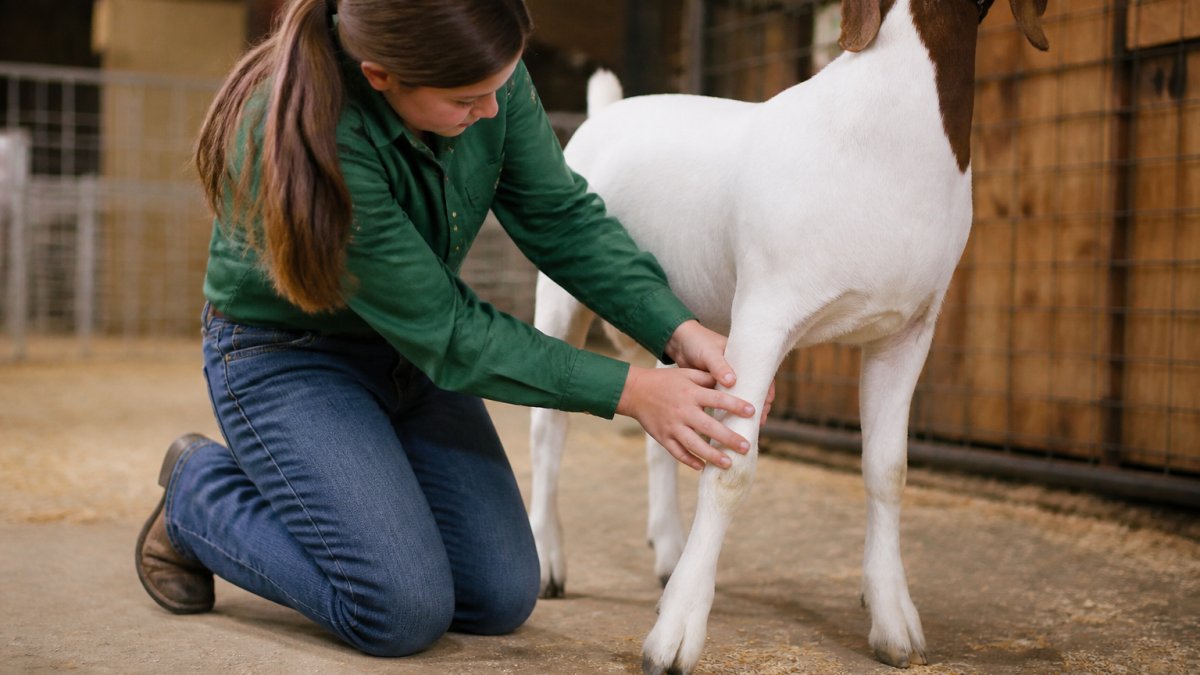
Swollen joints feel warm and appear enlarged compared to the opposite side. Run your hands over the knees, hocks, elbows, and fetlocks: normal joints feel cool and firm, inflamed joints warm and puffy. Heat signals active inflammation, call your veterinarian. Swelling without heat may indicate chronic changes, but warmth means infection or acute inflammation.
Arthritis in Goats: Symptoms and What They Mean
Arthritis develops as joint cartilage deteriorates, and can be acute (sudden heat, swelling, severe lameness) or chronic (slow stiffness that improves with movement). Symptoms include joint swelling, reduced range of motion, and difficulty moving; your goat may shift weight off the affected limb, refuse to jump or climb, or struggle to stand.
Swollen Joints in Goat Kids: Early Warning Signs
Swollen joints in young goats demand immediate attention. Kids are vulnerable to joint ill, a bacterial infection that causes rapid joint damage, typically within the first weeks of life.
Joint Ill in Goats: Acute Infection vs. Chronic Stiffness
Joint ill, also called septic arthritis, is an acute bacterial infection inside the joint space, a medical emergency rather than a management problem. It differs from chronic joint stiffness in cause, speed, and severity.
What Causes Joint Ill
Bacteria enter the bloodstream and settle in the joint lining. In kids, the usual route is the navel stump or mouth in the first hours and days of life, especially with poor colostrum intake or a wet, dirty kidding environment; common organisms include Escherichia coli, Streptococcus species, and Staphylococcus species. In older goats, bacteria reach a joint through a wound, an upward-tracking hoof abscess, or a contaminated injection site.
How It Presents by Age
Kids (first days to weeks): One or more hot, swollen joints, often the carpus (knee) or hock, with dullness, off feed, slow to rise, and fever.
Growing goats: A single swollen joint after a wound, hoof problem, or recent injection, with lameness worsening over 24-48 hours.
Mature goats: Less common but more dangerous, because it can mimic chronic arthritis until the joint is suddenly hot and the goat is systemically ill.
Acute vs. Chronic: Telling Them Apart
| Feature | Acute (septic / joint ill) | Chronic stiffness |
|---|---|---|
| Onset | Hours to a few days | Weeks to months |
| Joint heat | Marked | Minimal or none |
| Swelling | Rapid, often dramatic | Gradual, firm |
| Fever | Common | Usually absent |
| Appetite | Reduced or off feed | Normal |
| Attitude | Depressed | Bright |
| Response to movement | Worse with any use | Often loosens with movement |
A goat with acute septic arthritis is sick as a whole animal; one with chronic stiffness is usually bright and eating. That distinction is your fastest triage tool.
Red Flags That Require Same-Day Veterinary Care
- A kid that will not stand or nurse
- Fever combined with a hot, swollen joint
- A joint that swells visibly over a few hours
- Multiple swollen joints
- Inability to bear weight on a limb
- Discharge or an open wound over a joint
- Rapidly worsening lameness
Why Self-Treatment Fails
Antibiotics must reach the joint space at an effective concentration, and the drug depends on the organism and the goat's age and weight. Your veterinarian may also need to sample joint fluid, take radiographs, or drain a joint under sterile conditions. Guessing at home delays the one thing that matters, time.
What Chronic Stiffness Needs Instead
Chronic joint stiffness is managed, not cured. Supportive care includes controlled exercise on soft footing, weight management, hoof trimming every 6-8 weeks, and nutritional support with glucosamine and hyaluronic acid. Your veterinarian can confirm the diagnosis and rule out an underlying infection.
Goat Lameness Causes: Identifying the Root Problem
Lameness in show goats stems from several sources. Overgrown feet and poor hoof care create mechanical stress and abnormal weight distribution that strains the knees and hocks. Joint inflammation from overuse or trauma causes acute lameness, a goat that lands wrong or slips on wet ground may develop sudden joint pain and swelling.
At-Home Assessment: What to Observe Before the Show
Judges score movement, stance, and structural correctness, and a quietly stiff goat loses points on drive, extension, and balance long before it looks obviously lame. Run this assessment once daily during show season and twice weekly in the off-season, about five minutes per animal.
Step 1: Watch Movement on a Known Surface
Move your goat on flat, firm ground first, then on a slight incline, watching from the side, behind, and front.
- Walk: Look for even stride length front and rear. A shortened stride on one side is the earliest sign of joint discomfort.
- Trot: Ask for a trot on a lead. Trot exaggerates asymmetry that a walk hides; subtle hock or knee stiffness often only becomes visible at the trot.
- Turn: Ask the goat to circle both directions. A goat with a stiff joint will resist or swing wide on the affected side.
- After rest: Re-check movement after the goat has been stalled for an hour or more. Stiffness that worsens after rest points toward chronic joint change; stiffness that improves with movement is a common arthritis pattern.
Step 2: Compare Limbs Side by Side
Stand behind the goat and compare the left and right hock, then the left and right knee. Look for asymmetry in size, angle, and fill.
- Normal joints feel cool, firm, and symmetrical.
- A joint that is warm, puffy, or visibly larger than its opposite is a concern.
- Press gently and watch the goat's face and ears for a pain response. Ears back or a flinch is meaningful.
Step 3: Check Range of Motion
Gently flex and extend each joint through its normal arc without forcing it. A normal joint moves smoothly with no grating or resistance; a stiff joint feels tight, may creak, and the goat pulls away before you reach the end of the arc.
Step 4: Score and Record
Use a simple 0-3 scale for each limb so you can track change over time:
| Score | Meaning |
|---|---|
| 0 | Normal, even stride, cool joint, full range |
| 1 | Subtle, slight shortening or warmth, no lameness at walk |
| 2 | Obvious, visible lameness, swelling, or heat |
| 3 | Severe, refuses to bear weight, marked swelling, distress |
Record the date, limb, score, and what you saw. A written log lets your veterinarian see a timeline instead of a snapshot.
Step 5: Rule Out the Obvious Before You Worry About Joints
Not every stiff goat has joint disease. Before assuming the worst, check the feet: overgrown or abscessed hooves, foot rot, and sole bruises all produce a stiff, choppy gait that mimics joint pain. Pick up each foot, clean the sole, and look for heat, swelling at the coronary band, or a foul smell.
Step 6: Handle and Move a Stiff Goat Safely
A goat in joint pain can be unpredictable. Use a well-fitted collar or halter with a firm but gentle hand, never jerking the lead or forcing a trot on hard concrete, and provide non-slip footing in the aisle and pen.
A goat showing early stiffness may benefit from controlled exercise, proper nutrition, and joint support. Royal Grand formulates products like HyFlex and MOVERITE with glucosamine, hyaluronic acid, and MSM to support joint flexibility and connective tissue health during demanding show seasons.

When to Call Your Veterinarian
Not every stiffness requires a vet visit, but some signs demand immediate evaluation.
Call your veterinarian immediately if you observe:
- Sudden onset of severe lameness
- Joint heat or obvious swelling
- Fever combined with joint signs
- Multiple swollen joints
- Reluctance to stand or move
- Signs of pain when you touch a joint
- Discharge from a joint
Schedule a routine appointment if you notice:
- Mild lameness that persists for more than a few days
- Chronic stiffness that worsens over time
- Reduced range of motion without acute signs
- Changes in gait that affect show performance
Your veterinarian can perform a thorough joint examination, take radiographs if needed, and recommend treatment. Early assessment prevents small problems from becoming show-ending injuries.
Supporting Joint Health in Show Goats
Proper nutrition supports joint structure and function throughout your goat's life.
Royal Grand's HyFlex contains Type II Collagen, hyaluronic acid, and turmeric extract combined with glucosamine, MSM, and essential minerals to support healthy connective tissue and joint recovery. For liquid supplementation, MOVERITE delivers hyaluronic acid, glucosamine, MSM, and natural Vitamin E in a palatable livestock formula.

Feed quality matters too.
Regular hoof care prevents mechanical stress on joints. Trim hooves every 6-8 weeks and address overgrowth immediately, as it creates abnormal joint loading that leads to lameness.
Monitor body condition. Overweight animals stress their joints, while lean, muscular animals move more freely and show better in the ring.
Frequently Asked Questions
What are the most common signs of joint stiffness in show goats?
The primary signs of joint stiffness in show goats include reluctance to stand or walk, a stiff or shortened gait, visible swelling around joints (knees, hocks, elbows), warmth in affected areas, and reduced range of motion. You may also notice the goat favoring one limb or moving with an uneven, choppy stride. In show settings, stiffness becomes apparent during the walk-around when judges evaluate movement and frame.
How can I tell the difference between joint ill and arthritis in goats?
Joint ill typically appears suddenly in young kids, often within the first weeks of life, with acute swelling, heat, and fever. Arthritis develops gradually and is often chronic. Joint ill is usually caused by bacterial infection entering through the navel or wounds, while arthritis can result from infection, injury, or age-related wear. A veterinarian can confirm the diagnosis through joint fluid analysis and radiographs to guide treatment.
Can joint supplements help prevent stiffness in show goats?
Joint supplements containing glucosamine, hyaluronic acid, and MSM support connective tissue health and may help maintain mobility, especially during the stress of competition season. Products like HyFlex ($148.00) and MOVERITE ($250.00 per gallon) are formulated specifically for showstock and include ingredients designed to support joint flexibility and recovery. However, supplements work best as part of a complete nutrition plan and cannot replace veterinary treatment for existing joint disease.
When should I seek veterinary care for a stiff or lame goat?
Contact your veterinarian immediately if your goat shows sudden lameness, fever, severe swelling, or reluctance to bear weight on a limb. If stiffness worsens over days or affects multiple joints, professional evaluation is essential. For show goats with mild stiffness that develops gradually, schedule an exam before competition season to rule out serious joint disease and develop a management plan that keeps your animal competitive and comfortable.
Joint stiffness in show goats signals that your animal needs attention. Early detection through daily observation and prompt veterinary care when needed preserves soundness and extends your goat's competitive life. Royal Grand supports your efforts with premium joint supplements formulated specifically for showstock. Start with a solid foundation of proper nutrition, controlled exercise, and targeted joint support. Your goat will thank you with improved movement and better show performance.