

Table of Contents
- Why Supplements Matter for Show Animal Growth and Development
- Understanding Supplement Benefits for Animal Growth and Overall Health
- Show Steer Supplements for Growth: Species-Specific Strategies
- Show Goat Supplements: Nutrition for Frame and Finish
- Livestock Joint Supplements: Supporting Soundness and Mobility
- Show Livestock Supplement Feeding Guide: Dosage, Timing, and Safe Transitions
- Comparing Key Supplement Products: Ingredients, Pricing, and Performance
- Common Mistakes in Show Animal Supplementation and How to Avoid Them
- Frequently Asked Questions
Last Updated: October 21, 2026
Why Supplements Matter for Show Animal Growth and Development
Supplements for show animal growth are essential tools for exhibitors competing in 4-H, FFA, and professional show circuits.
The challenge is knowing which supplements deliver results versus which are just expensive feed additives.
This guide breaks down how supplements for show animal growth work, which products address specific needs across cattle, goats, sheep, and swine, and how to build a feeding program that produces real results without guesswork.
Understanding Supplement Benefits for Animal Growth and Overall Health
Supplements fill nutritional gaps that standard rations leave behind. A quality grain mix and hay provide baseline nutrition, but show animals under the stress of training, transportation, and competition need targeted support in specific areas.
The most effective supplements address four core needs: structural support for frame and bone development, muscle building through amino acids, joint and connective tissue integrity, and digestive health for feed efficiency.
Muscle Mass, Shape, and Body Condition
Muscle development depends on protein quality and amino acid availability. Standard feeds deliver protein, but not always in the form the body can most efficiently use for muscle deposition.
The visible result is an animal that fills out more completely through the rib, loin, and hindquarter. Royal Grand's Mighty Vite, for example, combines egg and whey protein isolate with a thoroughbred premix to support this kind of targeted muscle development.

Hoof and Horn Health
Soundness depends partly on hoof and horn integrity. Animals with weak or brittle hooves move differently, stand poorly, and present a less competitive appearance.
When hooves are strong and well-formed, animals move with confidence and stand squarely, details that influence judge perception before the animal is even evaluated for structure.
Digestive Health and Feed Efficiency
An animal that doesn't digest feed efficiently wastes money and potential.
Digestive support also helps animals maintain their condition and appetite even when circumstances change.
Show Steer Supplements for Growth: Species-Specific Strategies
Beef cattle require frame development and muscle shape that differs from other livestock.
Young steers benefit most from macro and trace minerals that support dense frame structure. Frameworx delivers red algae calcium and proteinated trace minerals (zinc, copper, manganese) that drive bone deposition and frame growth, the foundation all muscle development sits on.

As steers progress toward show readiness, the focus shifts to muscle definition and polish. This is where protein and amino acid supplements become critical.
The timeline matters. Starting mineral support early in a steer's growth phase and then layering in protein support as the animal matures produces better results than applying both simultaneously or waiting until late in the season.
Show Goat Supplements: Nutrition for Frame and Finish
Goats present unique challenges because their smaller frame means every nutrient decision has proportionally larger impact.
Frame development in show goats depends on consistent mineral intake throughout the growing phase. Goats are also more sensitive to feed changes and travel stress, which makes digestive support especially valuable during the show season. Nutrimix, with its daily vitamin and mineral premix including chelated trace minerals, B vitamin complex, and yeast cultures, provides the consistent nutritional foundation goats need.

For dairy or meat goats competing in shows, the combination of frame support early and muscle-building amino acids later produces animals that stand out for both structure and condition. The key is starting supplementation early enough that the animal's frame development isn't compromised by nutritional gaps in the first months of life.
Livestock Joint Supplements: Supporting Soundness and Mobility
Joint health becomes critical as show animals age and training intensity increases. Young animals can often compensate for minor joint stress, but in serious competition, joint integrity directly affects how an animal moves and stands.
Royal Grand's formulations emphasize hyaluronic acid, glucosamine, and MSM. These ingredients work best delivered consistently over time rather than as emergency interventions.
This is especially important for animals competing multiple times per season or traveling frequently. The repetitive stress of training and showing compounds over time.
Show Livestock Supplement Feeding Guide: Dosage, Timing, and Safe Transitions
Getting supplementation right requires more than picking the right product. Dosage, timing, and how you transition animals onto supplements all affect whether you see results or waste money.
When to Start Supplementation by Growth Stage
Timing supplementation matters more than most exhibitors realize.
Protein and amino acid supplements become more valuable as animals approach their growth acceleration phase, typically around 6-12 months depending on species.
Joint supplements should begin before visible problems appear, ideally 6-8 weeks before serious training or showing begins. This allows the compounds to accumulate in joint tissue and provide protection before stress loads increase.
Measuring Results with Practical Growth Metrics
Tracking whether supplements work requires specific metrics, not subjective observation.
Frame dimension is more telling. Measure heart girth, hip width, and rib depth every 2-3 weeks; animals on effective frame-building supplements show consistent increases.
Muscle definition and polish are subjective, but they're also the most visible to judges.
Hoof quality and hair coat condition are practical indicators of mineral status.
| Metric | Measurement Frequency | What It Tells You |
|---|---|---|
| Heart girth | Every 2-3 weeks | Frame development and overall growth |
| Hip width | Every 3-4 weeks | Structural growth and maturity |
| Muscle definition | Weekly photos under consistent lighting | Protein and amino acid effectiveness |
| Hoof quality | Visual inspection weekly | Trace mineral absorption and status |
| Weight gain | Every 1-2 weeks | Overall energy balance and feed efficiency |
Comparing Key Supplement Products: Ingredients, Pricing, and Performance
Royal Grand offers three core products addressing different phases of show animal development. Each fills a specific role in a comprehensive supplementation strategy.
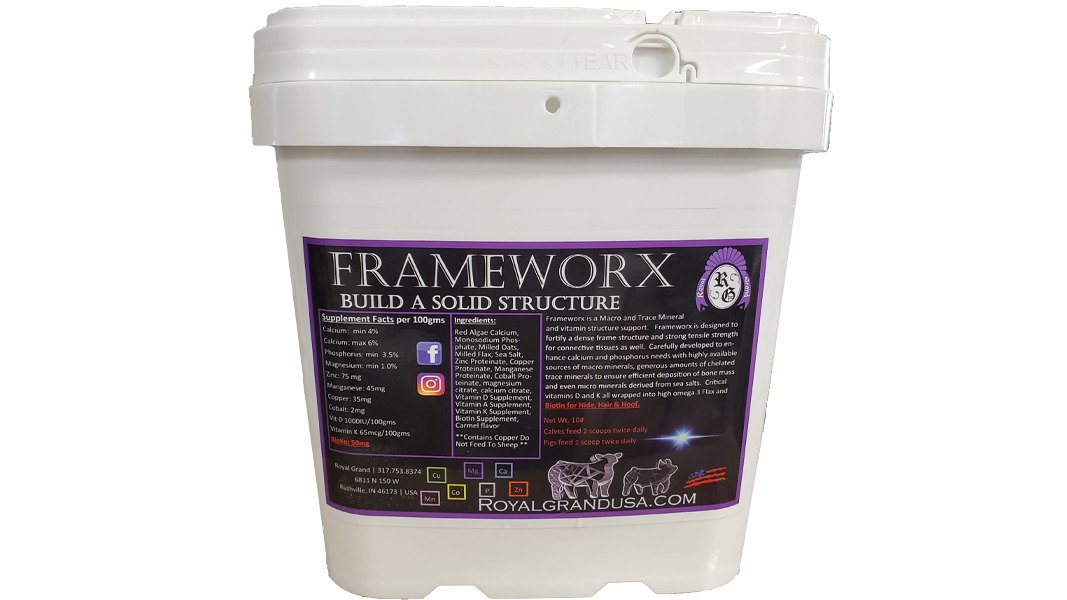
Frameworx: Macro and Trace Mineral Support
Frameworx ($75.00 for 10 pounds) is the foundation product for frame development, delivering red algae calcium, monosodium phosphate, and chelated trace minerals including zinc, copper, manganese, and cobalt proteinate.
It's most valuable for young animals in their growth phase and any animal where frame development is the priority.
Frameworx works best when fed consistently throughout the growing phase rather than as an occasional addition.
Mighty Vite: Protein and Amino Acid Development
Mighty Vite ($178.00 for 20 pounds) combines egg and whey protein isolate with critical amino acids and a thoroughbred premix, designed for the phase when muscle development and polish become the priority, typically the 3-6 months leading into show season.
The high-biological-value proteins and amino acid profile (lysine, threonine, methionine) drive muscle deposition and definition.
Mighty Vite contains no fillers or added animal fats, which means every scoop delivers active ingredients rather than inert bulk.
Nutrimix: Daily Vitamin and Mineral Premix
Nutrimix ($225.00 for 20 pounds) provides daily vitamin and mineral support focused on consistency and completeness, including chelated trace minerals, amino acids (lysine, threonine, methionine), B vitamin complex, all-natural vitamin E, selenium, yeast cultures, and enzymes.
This product works as a comprehensive daily supplement rather than a specialized tool for one phase.
Nutrimix is often used as the baseline supplement throughout the year, with Frameworx or Mighty Vite added depending on the current growth phase and priority.
Common Mistakes in Show Animal Supplementation and How to Avoid Them
Most exhibitors don't fail because they pick the wrong product.
The biggest mistake is treating supplements as emergency fixes rather than planned nutrition.
Another common error is underdosing.
Inconsistent feeding also sabotages results.
Finally, many exhibitors fail to match their supplement strategy to their animal's actual needs and current growth stage.
Show animal success depends on consistent, strategic nutritional support that matches your animal's growth stage and competitive goals.
Frequently Asked Questions
What are the best supplements for show steers?
The best supplements for show steers combine frame development, joint support, and digestive health. Frameworx provides macro and trace minerals for dense bone structure, while Mighty Vite delivers high-biological-value proteins and amino acids for muscle mass and shape. Nutrimix offers daily vitamin and mineral support with chelated trace minerals for efficient nutrient absorption. Most successful show steer programs layer these products based on growth stage, starting with foundational nutrition and adding joint support as animals approach show season. Results depend on consistent feeding, quality base ration, and matching the supplement to your animal's specific needs.
How do I know if a supplement actually improves joint soundness and mobility?
Track measurable changes over 6-8 weeks: observe stride length and movement quality at walk and trot, note any reduction in stiffness after rest periods, and assess weight distribution and stance balance. Joint soundness shows in how evenly an animal moves across all four limbs and how quickly it recovers from exercise. Document photos and video from the same angle weekly to spot subtle improvements in frame angle and movement that daily observation might miss. Real results appear gradually; expect noticeable changes by week 6-8 if the supplement and base nutrition are appropriate for your animal.
Can show animal supplements replace a balanced feed ration?
No. Supplements fortify and rebalance a quality base ration; they do not replace it. Show animals need adequate energy, protein, and forage from their main feed to support growth and show performance. Supplements fill specific nutritional gaps, such as biotin for hoof health, chelated minerals for absorption, or amino acids for muscle definition. A balanced ration plus targeted supplements produces results that neither can achieve alone. Relying only on supplements without proper base nutrition will waste money and fail to deliver the frame development, muscle mass, and finish that win in the show ring.
What is the difference between chelated trace minerals and other mineral forms in supplements?
Chelated trace minerals (like those in Nutrimix and Frameworx) are bound to amino acids. Non-chelated minerals often pass through the digestive tract without full absorption, reducing their impact on growth and show readiness.
When should I start feeding supplements to a show animal?
Begin foundational supplementation (vitamins, minerals, and digestive support) early in the animal's growth phase, typically 60-90 days before intensive training or show season. Frameworx and Nutrimix work best when fed consistently from the start to build dense frame structure and support nutrient absorption. Add protein and amino acid supplements (like Mighty Vite) 45-60 days before peak show season to support muscle development and shape. Electrolyte and probiotic support (Nutra Pulse) becomes critical during show travel and competition stress. The earlier you establish consistent supplementation aligned with your animal's growth stage, the more time nutrients have to deposit in bone, muscle, and connective tissue, resulting in a more polished finish and sounder animal in the ring.
Are Royal Grand supplements allowed in FFA and 4-H livestock shows?
Most Royal Grand supplements are compliant with FFA and 4-H rules, as they contain natural vitamins, minerals, amino acids, and enzymes without prohibited growth promotants. However, show rules vary by state and competition level. Before purchasing, verify the specific rules for your show or state association, check the official rulebook or contact your county extension office or show superintendent. Royal Grand products are formulated for show animals and designed to support natural growth and health without banned substances, but it's your responsibility to confirm compliance before using any supplement in a sanctioned competition. When in doubt, ask the show's veterinarian or rules committee directly.
What is the cost-effectiveness of show animal supplements, and when is supplementation not necessary?
Supplements range from $45 to $225 per product and typically last 4-12 weeks depending on animal size and feeding rate. For a single show animal on a tight budget, start with Frameworx ($75) or Nutrimix ($225) rather than buying multiple products. Supplementation is most cost-effective when your base ration is already balanced and your animal has genetic potential to express growth and show qualities. If your animal lacks appetite, has digestive issues, or is recovering from illness, addressing those problems first yields better returns than adding supplements. Supplementation is unnecessary if you're not competing, if your animal is already performing well on current nutrition, or if budget constraints force a choice between quality base feed and supplements, always prioritize the base ration first.
How do I transition my show animal to a new supplement without digestive upset?
Introduce new supplements gradually over 7-10 days by mixing the new product with the old one, increasing the new supplement's portion each day until you reach the full recommended amount. This gradual transition allows the animal's digestive system and microbiome to adjust without causing loose stool, reduced appetite, or performance dips. Start at 25% new supplement and 75% old on day 1, move to 50/50 by day 3-4, and reach 100% new by day 7-10. If your animal shows any digestive upset during transition, slow the process by an additional 3-5 days. Nutra Pulse's probiotics and essential oils support gut health during transitions and are especially helpful when changing supplements or managing stress from travel to shows.